
近日,中国科学院武汉病毒研究所石正丽与崔杰课题组在SARS冠状病毒起源与进化研究中取得新进展,该团队在我国云南省发现了一处蝙蝠SARS样冠状病毒的天然基因库,揭示了SARS冠状病毒可能的重组起源。

菊头蝠携带遗传多样的SARS样冠状病毒(图片由广东省生物资源应用研究所张礼标研究员提供)
蝙蝠是SARS样冠状病毒的自然储存宿主。自2005年以来,多个研究团队在我国、欧洲不同地区的多种菊头蝠中发现了越来越多的SARS样冠状病毒。然而,大部分蝙蝠SARS样冠状病毒的刺突蛋白基因(S基因)和部分附属基因(如ORF3、ORF8等)与SARS冠状病毒差异明显。所有目前已报道的蝙蝠SARS样冠状病毒至少在两个基因上与SARS冠状病毒存在较大分化。因此,它们都不是造成2002-2003年疫情的SARS冠状病毒的直接祖先。虽然目前已有充分证据表明蝙蝠是SARS病毒的源头,但有关SARS如何在蝙蝠中进化产生、从哪里的蝙蝠种群中出现等问题还未得到解答。
石正丽研究团队自2011年起对云南省一处洞穴的菊头蝠种群开展了为期五年的SARS样冠状病毒的长期监测,共进行了10次样品采集,在64份蝙蝠粪便粒和肛拭子样品中检测到了SARS样冠状病毒RNA。对这些SARS样冠状病毒S基因受体结合区(Receptor-binding domain, RBD)的扩增与分析结果显示,流行于这一洞穴的蝙蝠SARS样冠状病毒高度多样,可分为两大簇,其中一簇在RBD区更接近SARS病毒,不存在大部分SARS样冠状病毒所出现的缺失。作者对11株新发现的SARS样冠状病毒进行了全长基因组扩增,并对15株在该洞穴发现的毒株(含4株前期已报道的毒株)进行了全基因组序列分析。结果表明,流行于该洞穴的蝙蝠SARS样冠状病毒在非结构蛋白基因ORF1ab上彼此相近,然而它们的S基因和ORF8基因却呈现极为丰富的遗传多样性。重要的是,在S基因的N端区域(N-terminal domain,NTD)、RBD区、ORF3、ORF8这几个基因组高变区上分别与SARS病毒高度同源的SARS样冠状病毒均存在于该洞穴的蝙蝠中。换言之,SARS冠状病毒的全部基因组组分都可以在这个SARS样冠状病毒的天然基因库中找到。通过进一步的重组分析,作者在这些SARS样冠状病毒S基因内部和ORF8附近等多个位点发现了频繁重组的证据,并推测SARS冠状病毒的直接祖先可能通过这些蝙蝠SARS样冠状病毒的祖先株之间发生的一系列的重组事件而产生。

流行于同一蝙蝠洞穴的15株SARS样冠状病毒与SARS冠状病毒全长基因组相似度比较
此外,该研究通过反向遗传学方法,将新发现毒株的S基因替换到已构建的WIV1株SARS样冠状病毒全长感染性克隆上,并对三株新发现的S基因不同的SARS样冠状病毒的跨种传播能力进行了评估。结果显示,S基因不存在缺失的多株SARS样冠状病毒均可在Vero E6细胞中有效复制,并可使用与SARS病毒相同的受体——人ACE2入侵HeLa细胞。除S基因以外,作者对新发现的蝙蝠SARS样冠状病毒中遗传多样的ORF8也进行了初步的功能研究。发现不同基因型的ORF8均具有和SARS病毒ORF8相类似的活化转录激活因子6(ATF6)的功能;而首次发现的具有和晚期SARS冠状病毒类似的ORF8a/8b的蝙蝠SARS样冠状病毒Rs4084株,其ORF8a也表现出诱导细胞凋亡的功能。综上,该研究为认识SARS冠状病毒的起源与进化提供了新的见解,研究揭示了我国蝙蝠携带有不同株具有跨种传播至人群可能性的SARS样冠状病毒,表明我国仍存在类似SARS的新发冠状病毒病暴发风险,为相关疾病的预防提供了重要依据。

S基因无缺失的三株不同蝙蝠SARS样冠状病毒均能感染Vero E6细胞。
文章在线发表后,被PLoS Pathogens杂志列为本周推荐文章。12月1日,Nature news对新发表的论文进行了报道,指出该发现回答了关于SARS病毒起源遗留的问题。报道援引香港大学知名微生物学家袁国勇教授的评论:“这项发现告诫我们需减少对蝙蝠等野生动物栖息地的侵扰、杜绝野生动物市场交易,这对于防止新发传染病的发生至关重要。”
该研究得到了国家自然科学基金(81290341, 31621061)、传染病防治重大专项(2014ZX10004001-003)、科技基础性工作专项(2013FY113500)、中科院先导科技专项(XDPB0301)、美国国立卫生研究院(NIAID R01AI110964)、美国国际开发署PREDICT项目、中国科学院“百人计划”、武汉病毒所“一三五”项目等项目资助。胡犇助理研究员、曾磊平博士、杨兴娄副研究员为文章共同第一作者,石正丽研究员和崔杰研究员为共同通讯作者。(武汉病毒研究所)

新闻多一点:
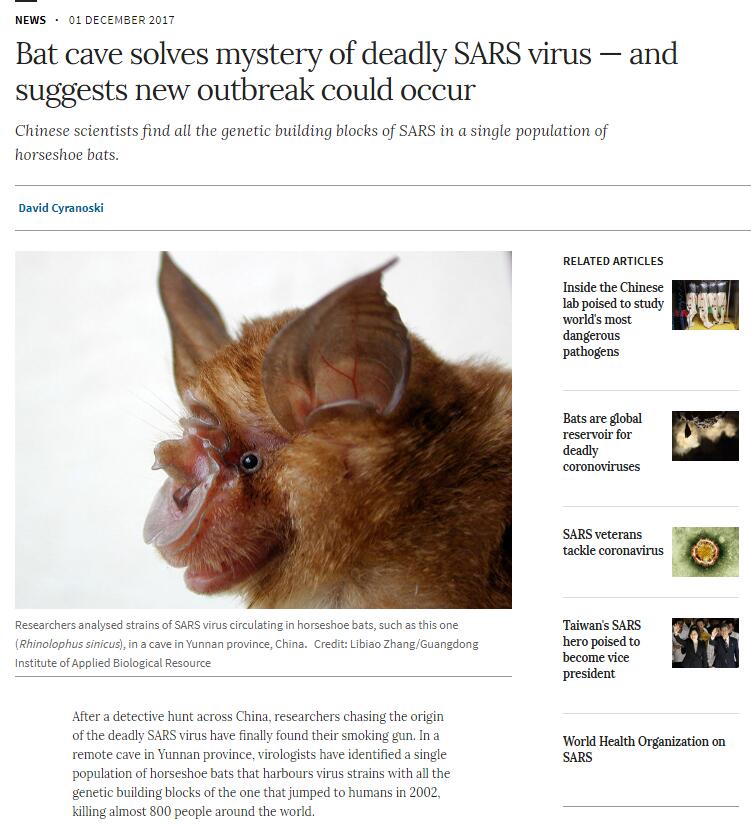
《自然》杂志网站截图
论文原文:
Bat cave solves mystery of deadly SARS virus — and suggests new outbreak could occur
Chinese scientists find all the genetic building blocks of SARS in a single population of horseshoe bats.

Researchers analysed strains of SARS virus circulating in horseshoe bats, such as this one (Rhinolophus sinicus), in a cave in Yunnan province, China.Credit: Libiao Zhang/Guangdong Institute of Applied Biological Resource
After a detective hunt across China, researchers chasing the origin of the deadly SARS virus have finally found their smoking gun. In a remote cave in Yunnan province, virologists have identified a single population of horseshoe bats that harbours virus strains with all the genetic building blocks of the one that jumped to humans in 2002, killing almost 800 people around the world.
The killer strain could easily have arisen from such a bat population, the researchers report in PLoS Pathogens on 30 November. They warn that the ingredients are in place for a similar disease to emerge again.
In late 2002, cases of a mystery pneumonia-like illness began occurring in Guangdong province, southeastern China. The disease, dubbed severe acute respiratory syndrome (SARS), triggered a global emergency as it spread around the world in 2003, infecting thousands of people.
Scientists identified the culprit as a strain of coronavirus and found genetically similar viruses in masked palm civets (Paguma larvata) sold in Guangdong’s animal markets. Later surveys revealed large numbers of SARS-related coronaviruses circulating in China’s horseshoe bats (Rhinolophus) — suggesting that the deadly strain probably originated in the bats, and later passed through civets before reaching humans. But crucial genes — for a protein that allows the virus to latch onto and infect cells — were different in the human and known bat versions of the virus, leaving room for doubt about this hypothesis.
Bat hunt
To clinch the case, a team led by Shi Zheng-Li and Cui Jie of the Wuhan Institute of Virology in China sampled thousands of horseshoe bats in locations across the country. “The most challenging work is to locate the caves, which usually are in remote areas,” says Cui. After finding a particular cave in Yunnan, southwestern China, in which the strains of coronavirus looked similar to human versions, the researchers spent five years monitoring the bats that lived there, collecting fresh guano and taking anal swabs.
They sequenced the genomes of 15 viral strains from the bats and found that, taken together, the strains contain all the genetic pieces that make up the human version. Although no single bat had the exact strain of SARS coronavirus that is found in humans, the analysis showed that the strains mix often. The human strain could have emerged from such mixing, says Kwok-Yung Yuen, a virologist at the University of Hong Kong who co-discovered the SARS virus: “The authors should be congratulated for confirming what has been suspected.”
But Changchun Tu, a virologist who directs the OIE Reference Laboratory for Rabies in Changchun, China, says the results are only “99%” persuasive. He would like to see scientists demonstrate in the lab that the human SARS strain can jump from bats to another animal, such as a civet. "If this could have been done, the evidence would be perfect,” he says.
Travel trouble
Another outstanding question is how a virus from bats in Yunnan could travel to animals and humans around 1,000 kilometres away in Guangdong, without causing any suspected cases in Yunnan itself. That “has puzzled me a long time”, says Tu.
Cui and Shi are searching for other bat populations that could have produced strains capable of infecting humans. The researchers have now isolated some 300 bat coronavirus sequences, most not yet published, with which they will continue to monitor the virus’s evolution.
And they warn that a deadly outbreak could emerge again: the cave where the elements of SARS were found is just 1 kilometre from the nearest village, and genetic mixing among the viral strains is fast. “The risk of spillover into people and emergence of a disease similar to SARS is possible,” the authors write in their paper.
Although many markets selling animals in China have already been closed or restricted following outbreaks of SARS and other infectious diseases, Yuen agrees that the latest results suggest the risk is still present. “It reinforces the notion that we should not disturb wildlife habitats and never put wild animals into markets,” says Yuen. Respecting nature, he argues, “is the way to stay away from the harm of emerging infections”.
原文作者:David Cyranoski
来源:时刻综合
作者:姜媚
编辑:姜媚